Top Refrigerator Repair Courses for Career Starters
Compare top refrigerator repair courses by hands-on diagnostics, refrigeration coverage, instructor support, and tools that prepare you for service work.
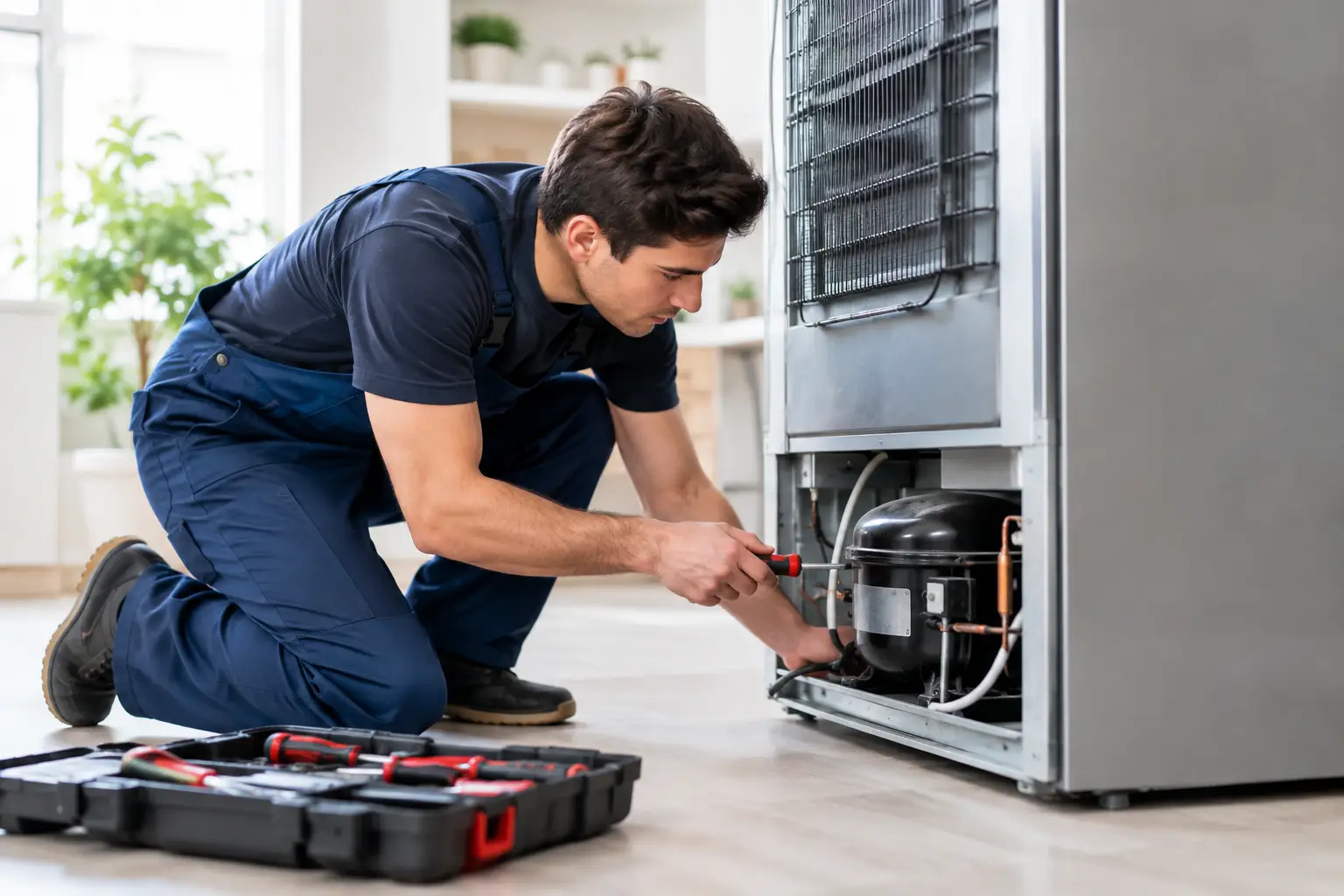
A refrigerator failure is rarely a single-part problem. A warm fresh-food section can trace back to airflow, a defrost circuit, a thermistor reading, a control-board output, a condenser issue, or a sealed-system fault. That is why the top refrigerator repair courses do more than show students how to swap common parts. They teach a diagnostic process that holds up when a customer needs an accurate answer, a clean estimate, and a repair that stays repaired.
For career changers and future service-business owners, course selection matters because refrigeration is one of the highest-value appliance categories in the field. It is also one of the easiest places to lose money if training skips electrical fundamentals, safety procedures, or the logic behind a diagnosis. The right program should help you move from "I recognize this part" to "I can test this circuit, document the failure, and explain the repair to the customer."
What separates top refrigerator repair courses from basic tutorials
A free video can be useful when you need to see where an evaporator fan sits or how a particular ice maker comes apart. It is not a training path by itself. Videos often show the successful repair but leave out the decisions that came before it: what symptoms mattered, what measurements ruled out other failures, and when a technician should stop rather than guess.
Strong refrigerator repair training follows the same sequence used on a service call. Start with the customer complaint and model information. Confirm operating conditions. Check for obvious airflow, frost-pattern, noise, or water-leak clues. Then use meter readings, wiring information, error codes, and component specifications to isolate the actual fault.
That workflow is what makes training employable. A service company does not need a technician who can name five likely bad parts. It needs someone who can arrive prepared, work safely around live voltage, protect the customer’s home, and produce a defensible diagnosis.
The curriculum should cover the whole refrigerator system
Look beyond a course description that simply promises "refrigerator repair." The category includes several systems that interact with one another. A useful course should address mechanical refrigeration, electrical circuits, electronic controls, defrost systems, airflow, ice production, water dispensing, and common customer-facing symptoms.
At a minimum, students should learn how to diagnose compressor-start problems, condenser and evaporator fan failures, defrost heater and bimetal or sensor issues, thermistor diagnostics, door-switch circuits, inlet valves, ice-maker faults, and control-board communication problems. Training should also explain why a refrigerator may cool poorly even when the compressor is running.
Sealed-system fundamentals deserve special attention. New technicians should understand the role of the compressor, condenser, evaporator, capillary tube or metering device, and refrigerant flow. But there is a practical distinction: understanding sealed-system symptoms is not the same as performing refrigerant recovery, evacuation, brazing, or charging. Those tasks require appropriate equipment, safety practices, and often EPA Section 608 certification. A credible course is clear about that line instead of overselling what an entry-level student can do on day one.
Electrical testing cannot be an afterthought
Many refrigerator callbacks begin with a parts-changing mistake. A technician sees a no-cool complaint, assumes a control board is bad, and installs an expensive part without confirming voltage, continuity, resistance, or the input condition that controls the board.
The best programs build electrical testing into every appliance category. You should learn safe multimeter setup, voltage checks, continuity testing, resistance measurements, wiring-diagram reading, and how to distinguish a failed component from a missing command signal. Lockout/tagout principles and safe work around energized equipment are not classroom filler. They are job-site habits that protect you, the customer, and the company you represent.
For example, a defrost complaint may require more than finding a frosted evaporator. A technician needs to determine whether the heater is open, the defrost sensor is out of range, the control is failing to initiate defrost, or a wiring connection has failed. The repair decision comes from the test path, not the appearance of the frost.
How to compare refrigerator repair training programs
The right course depends on your starting point and career target. Someone who already works for an appliance company may need targeted refrigeration training and a faster route to better diagnostics. A beginner who wants to enter the trade or build a local service business needs a broader foundation.
When comparing programs, ask whether refrigerator content sits inside a complete appliance-repair curriculum. That broader format usually delivers more job options. Most service calls are not refrigerator-only calls, and employers value technicians who can also handle washers, dryers, dishwashers, ranges, microwaves, and basic customer documentation.
Also examine how the course teaches. Reading manuals is necessary, but manuals do not create diagnostic instincts. Scenario-based exercises are more useful because they force you to interpret symptoms, select tests, review likely readings, and make a repair decision before you are standing in a customer’s kitchen.
Look for these practical signals of a field-ready program:
- Structured instruction in safety, tools, electrical theory, and diagnostic workflow before advanced refrigeration topics.
- Simulations or case studies that mirror real faults, including misleading symptoms and multiple possible causes.
- Graded coursework and an assessment that show whether you can apply the material, not just watch it.
- Instructor access or a technician community where you can pressure-test a diagnosis.
- Training on estimates, job tickets, repair notes, and customer-ready explanations.
- A clear path to employment, independent work, or business ownership after completion.
Price matters, but it should be evaluated against the full training package. A low-cost course that covers only refrigerator parts identification may leave you paying for separate electrical, business, or multi-appliance classes later. Conversely, a longer program is not automatically better if it is heavy on theory and light on diagnostic repetition. The useful question is whether tuition buys skills you can apply on a paid call.
Why simulations and support matter before your first service call
Refrigerator diagnostics can be expensive to learn through trial and error. Misdiagnose a sealed-system issue, install a board without testing the circuit, or overlook a damaged door gasket, and the cost may include a return trip, lost margin, and a frustrated customer.
Simulations compress that learning curve. They let you work through failures without the pressure of a live appointment. You can practice reading a symptom pattern, deciding what test comes next, and seeing how a wrong assumption leads to a wrong repair. That repetition matters because field work moves fast. Customers do not pay for a technician to search randomly through parts diagrams.
Support matters for the same reason. A newer technician will encounter model-specific details that do not match the training example exactly. Access to an instructor or knowledgeable peer community helps you learn how to reason from the circuit and system behavior rather than memorizing one model’s layout.
This is also where AI can be useful without replacing technician judgment. A field-focused diagnostic app can help identify components from a photo, surface error-code information, pull wiring references, guide multimeter checks, and organize job documentation. The technician still verifies the reading, follows safety procedures, and makes the call. AI shortens the search for information; it does not turn an untested guess into a diagnosis.
A career path should include more than the repair itself
Refrigerator training has real earning potential because these repairs are urgent, technical, and common. But income growth comes from more than knowing how to replace an evaporator fan. Technicians who earn trust document conditions clearly, communicate repair options honestly, manage parts efficiently, and know when a repair is not economically sensible for the customer.
That is especially relevant if you plan to operate independently. You need a repeatable intake process, model and serial-number capture, job tickets, estimates, payment procedures, and professional repair reports. A customer who understands what failed, what was tested, and why a repair is recommended is more likely to approve the work and refer you later.
Appliance Repair Academy is built around that broader launch path. Its 12-week program covers safety, electrical testing, refrigeration, laundry, cooking, dishwashers, microwaves, diagnostic workflow, documentation, and business operations. Students complete graded coursework, work through more than 80 scenario-based simulations, and finish with a 75-question certification assessment. Tuition also includes 12 months of access to the Appliance Repair Assistant AI app for field references, fault detection support, multimeter guidance, job ticketing, and customer-ready reporting.
Choose training that prepares you to think like a technician
A refrigerator repair course should give you more than confidence around a screwdriver. It should teach you how to protect yourself around electrical equipment, test before replacing, recognize the limits of your current scope, and communicate a repair decision with professionalism.
If you want a career that can lead to service-company work or an independent repair business, choose training built around repeatable diagnostics and real field workflows. Explore Appliance Repair Academy content to see the full training path, and download the companion Appliance Repair Assistant AI app to put practical diagnostic support alongside your hands-on training. The next service call is where knowledge becomes income.
Keep reading
How to Become an Appliance Repair Technician
Read moreAppliance Repair Certifications
Read moreAppliance Repair Technician Salary
Read moreLearn this the repeatable way
The Appliance Repair Academy is a 12 week online certification taught by a working technician. Tuition is $949 and covers laundry, refrigeration, cooking, and dishwasher systems, with the Appliance Repair AI diagnostic app included for a full year.
Explore the program