Appliance Service Industry Trends Shaping 2026
Appliance service industry trends are creating stronger opportunities for technicians who can diagnose smart systems, document work, and run more routes.
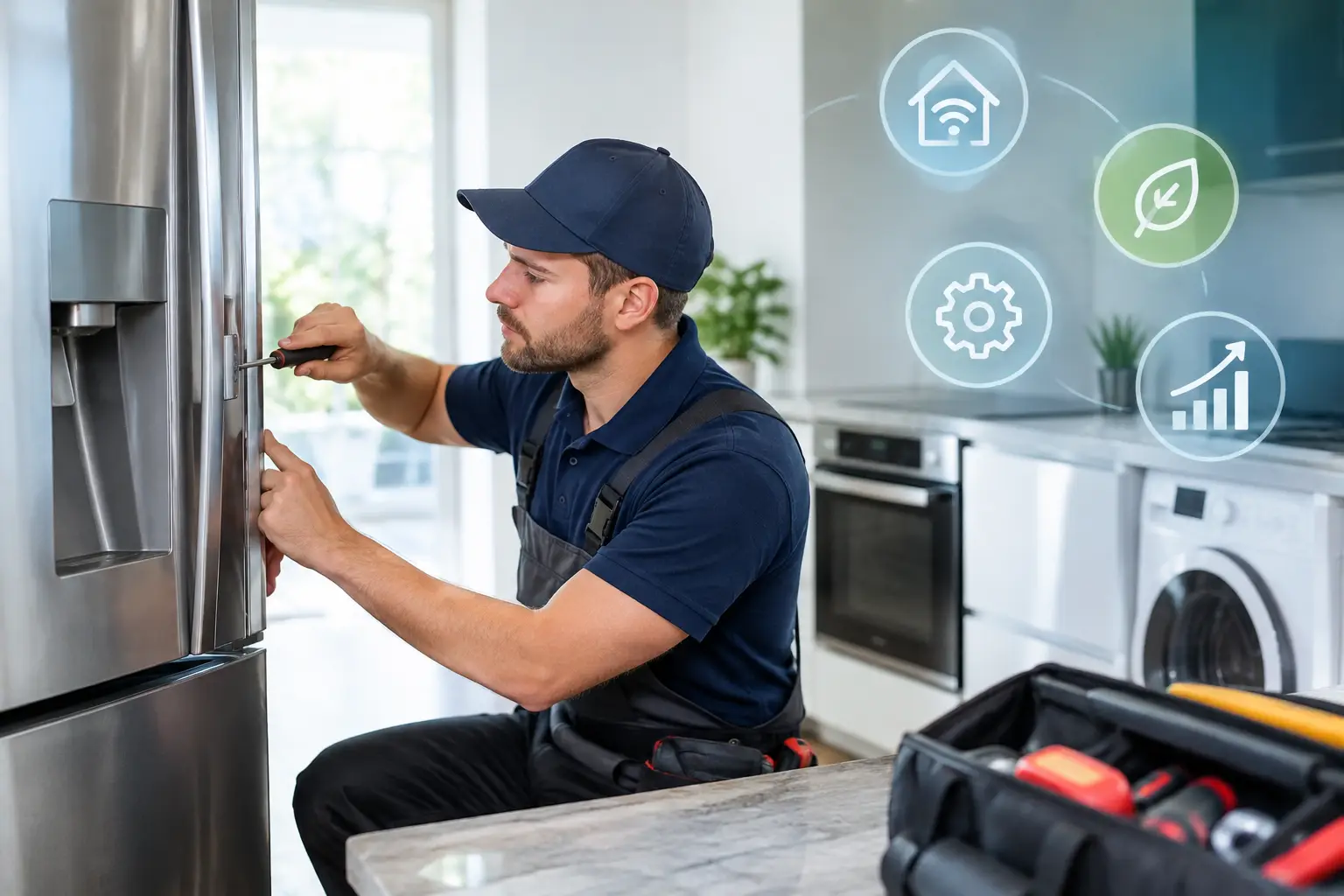
A refrigerator with a touchscreen, a washer sending fault codes to an app, and a customer expecting a repair update before the technician leaves the driveway - this is no longer the edge of the trade. It is the working reality. The appliance service industry trends shaping 2026 are raising the value of technicians who can diagnose electrical systems, communicate clearly, and complete repairs with fewer return visits.
For someone entering the field, that is good news. Appliances are not getting simpler, but the work is becoming more structured for technicians who learn a repeatable diagnostic process. The opportunity is not limited to replacing parts. It is built around finding the actual failure, documenting the job, earning customer trust, and running an efficient service route.
Smart Appliances Are Expanding the Diagnostic Skill Set
Connected features are now common across laundry, refrigeration, cooking, and dishwashing equipment. That does not mean every service call requires software expertise. It does mean a modern technician needs to be comfortable working from error codes, service diagnostics, wiring diagrams, sensor readings, and manufacturer test modes.
A smart washer may report a communication fault, but the root cause can still be physical: a damaged harness, low-voltage power issue, failed control board, loose connector, or moisture intrusion. The screen provides a clue. It does not replace testing.
That distinction matters for new technicians. Customers may see an error code and assume they have already identified the problem. A trained technician knows a code is the start of the workflow, not the final diagnosis. Confirm the complaint, check the installation and power supply, inspect connections, test components, and verify operation after the repair.
This is why electrical fundamentals remain the foundation of the trade. Reading voltage, resistance, continuity, and frequency correctly helps a technician work across brands and appliance categories instead of becoming dependent on guesswork or parts swapping.
First-Visit Fix Rates Matter More Than Ever
Service companies make money when trucks move efficiently, repairs are completed correctly, and customers do not need to schedule another appointment for the same issue. A missed diagnosis can turn a profitable call into a return trip, an unhappy customer, and a negative review.
One of the most practical appliance service industry trends is the growing focus on first-visit resolution. Technicians are expected to arrive prepared, ask better questions, identify likely failure points, and document enough detail to order the right part when a repair cannot be completed that day.
That creates a strong advantage for technicians who use a consistent workflow. A solid call begins before the door opens. Review the model number, complaint, prior notes, and available error codes. At the home, protect the work area, verify the symptom, and follow safe shutdown procedures. Lockout/tagout is not paperwork for its own sake. It protects the technician and the customer when working around live voltage, sharp metal, hot surfaces, moving components, and refrigerant systems.
After the repair, technicians need to test the appliance through the relevant portion of its cycle and explain the result in plain language. That final verification is where good service becomes a referral-producing experience.
AI Is Becoming a Field Tool, Not a Replacement for Technicians
AI will not pull a range away from the wall, recover refrigerant, test a defrost circuit, or determine whether a compressor windings reading makes sense in the context of the whole sealed system. Hands-on judgment remains the center of appliance repair.
What AI can do is reduce wasted time around the work. A technician can use AI-assisted tools to look up error codes, organize job notes, identify common failure patterns from a photo, locate wiring references, or turn technical findings into a customer-ready report. Used correctly, it acts like a fast reference partner in the truck.
The trade-off is straightforward: faster information is only valuable when the technician can verify it. A tool may suggest checking a thermistor, but the technician still needs to know how to test it, what reading is expected at a given temperature, and whether the wiring and control board are also operating correctly.
Technicians who combine real multimeter skills with modern diagnostic support will be positioned well. They can move faster without treating an app, a code, or an online forum as proof of failure.
Refrigeration and Sealed System Work Continue to Separate Skill Levels
Basic appliance repairs create a path into the field, but refrigeration can increase a technician's value substantially. Customers replace refrigerators less casually when the appliance is expensive, built in, or part of a premium kitchen package. Service companies need technicians who can accurately determine whether a cooling complaint is caused by airflow, defrost, sensors, fans, controls, or a sealed system failure.
Sealed system fundamentals are particularly valuable because misdiagnosis is expensive. A refrigerator that is warm may have a failed evaporator fan motor or a defrost issue. Calling it a compressor problem without proper testing can lead to unnecessary parts, lost time, and damaged credibility.
This is also an area where training matters. Refrigeration work involves safety practices, recovery procedures, pressure and temperature relationships, and disciplined diagnosis. It is not a category to approach through trial and error. A technician who develops confidence in refrigeration expands both employment options and long-term business potential.
Customers Expect Professional Documentation
The repair itself matters. So does the record of the repair. Homeowners, property managers, warranty companies, and service businesses increasingly expect clear documentation of what failed, what was tested, what part was installed, and whether the unit was verified after service.
Good documentation protects everyone. It gives the customer a clear explanation of the bill. It helps an office team schedule follow-up work and order parts. It also gives the technician a record if the customer calls back weeks later with a different issue.
The strongest technicians learn to translate technical work into useful language. “Replaced bad part” is not a professional service note. “Verified 120 VAC supply, found open thermal fuse in blower circuit, replaced fuse after confirming vent restriction had been corrected, and tested heat cycle” tells the real story.
This skill becomes even more important for technicians who want to own a repair business. Clear notes, estimates, invoices, photos, and customer communication are operational tools. They support better reviews, fewer disputes, and a business that can scale beyond one person answering every phone call.
The Independent Business Path Is More Accessible
Appliance repair has always offered a route to self-employment, but modern scheduling, payment, dispatch, and diagnostic tools have lowered the administrative barrier. A technician does not need a large storefront to begin building a local service operation. They need technical competence, insurance and licensing awareness, a reliable vehicle, the right tools, disciplined pricing, and a process for communicating with customers.
That does not mean business ownership is automatic or easy. Running calls is different from running a company. Owners must manage parts costs, route density, callbacks, taxes, customer acquisition, and cash flow. They also need to decide which work to accept. A solo operator may do well by specializing in residential laundry, cooking, dishwashers, and refrigeration while avoiding categories that require equipment or certifications they do not yet have.
Still, the upside is real. Technicians who build diagnostic speed, professional habits, and customer trust can create an income path that is less dependent on traditional office employment and more connected to tangible results.
Training Is Shifting From Information to Field Readiness
Manuals and videos can teach terminology, but they do not automatically create a technician who can walk into a home and run a safe, logical service call. The strongest training programs focus on decision-making: what to check first, how to use a meter, when a reading proves a component has failed, how to avoid damaging a customer's home, and how to explain the outcome.
That is where simulations, graded coursework, and instructor feedback have practical value. They force learners to make choices before they are standing in front of a frustrated customer. A structured 12-week path that covers electrical testing, laundry, refrigeration, cooking, microwaves, dishwashers, diagnostic workflows, and business operations prepares students for more than a single appliance category.
Appliance Repair Academy approaches training with that field-first mindset, pairing technician-built instruction with 80-plus scenario-based simulations, a final certification assessment, and practical AI support for the job. The goal is not to memorize every model. It is to build a process that works when the model is unfamiliar.
The technicians who win in this market will not be the ones who guess fastest. They will be the ones who test safely, diagnose methodically, document clearly, and keep learning as appliances change. Explore Appliance Repair Academy content to see how that process is taught, and download the companion AI diagnostic app to put a practical field reference in your workflow.
Keep reading
How to Become an Appliance Repair Technician
Read moreAppliance Repair Certifications
Read moreAppliance Repair Technician Salary
Read moreLearn this the repeatable way
The Appliance Repair Academy is a 12 week online certification taught by a working technician. Tuition is $949 and covers laundry, refrigeration, cooking, and dishwasher systems, with the Appliance Repair AI diagnostic app included for a full year.
Explore the program