Analog Digital Multimeters for Appliance Repair
Learn when analog digital multimeters belong in appliance repair, how to test safely, and which readings lead to confident, billable service calls on site.
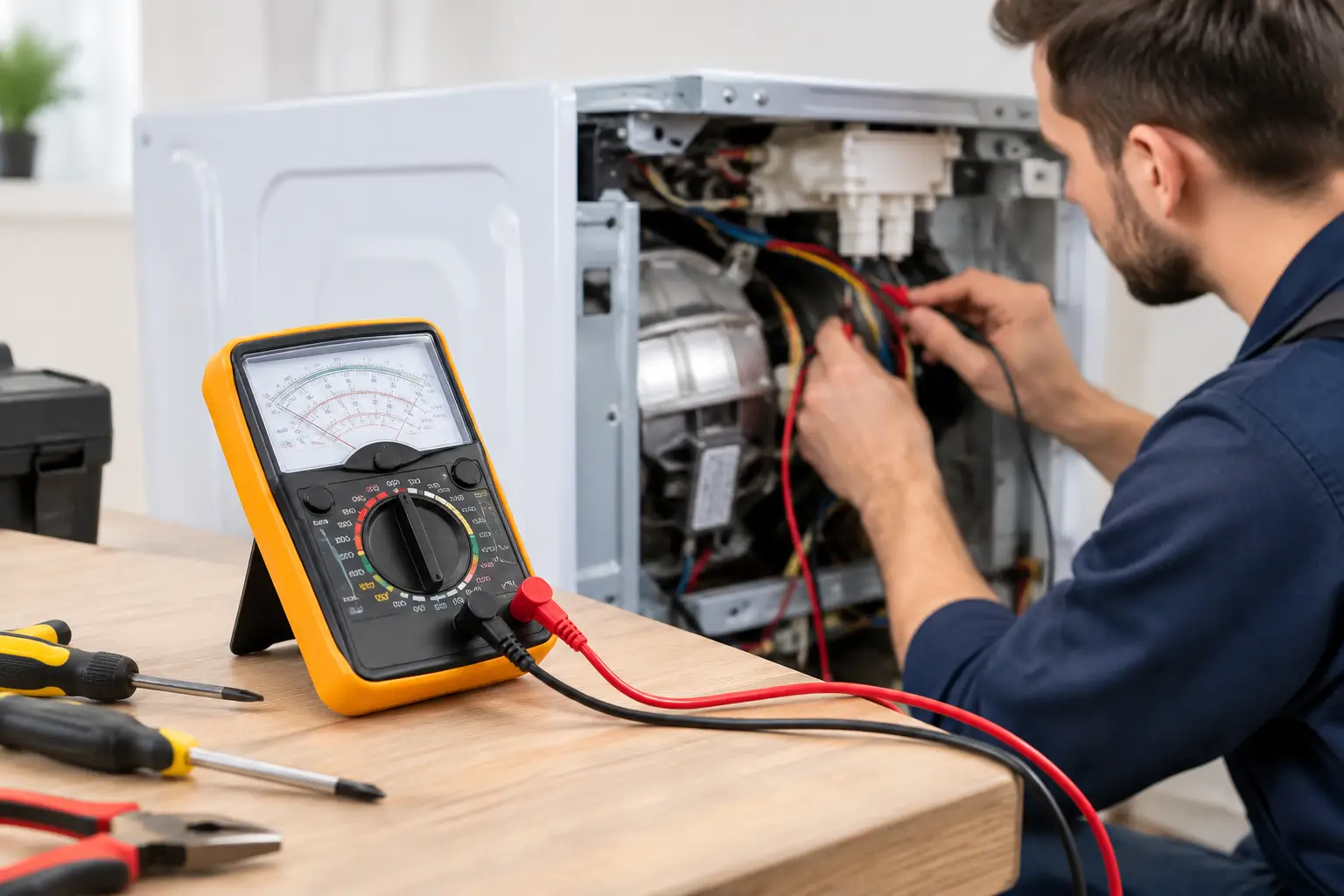
A no-cool refrigerator, a dryer that will not heat, and a dishwasher stuck mid-cycle can all look like major failures until the meter tells a different story. Analog digital multimeters are central to that decision-making process. A technician who can verify voltage, continuity, resistance, and component behavior does not guess at parts. They build a diagnosis, explain it to the customer, and move the service call forward.
For new appliance technicians, the question is not whether a meter matters. It is which type of meter fits the job, what each reading actually means, and how to test without creating a safety hazard or damaging a control board. Digital multimeters are the daily workhorse for most modern appliance service. Analog meters still offer a few useful advantages, especially when you need to watch a changing signal instead of a frozen number on a screen.
Analog vs. Digital Multimeters in Appliance Work
An analog multimeter displays a reading with a moving needle across a printed scale. A digital multimeter, often called a DMM, displays a numeric value on a screen. Both can measure core electrical values, but they do not behave the same way at the appliance.
A digital meter is generally the better first purchase for appliance repair. It is easier to read, usually more accurate, and better suited to the electronic controls found in modern refrigerators, washers, ranges, and dishwashers. When you are checking a thermistor at a specific temperature or confirming whether a control is sending 120 VAC to a load, a clear digital reading gives you a reliable data point for your diagnostic workflow.
Analog meters have a needle that reacts continuously. That movement can make an intermittent condition easier to spot. If a switch contact is opening and closing, or a sensor signal is fluctuating, a jumping needle may show the change faster than a display that updates in intervals. The trade-off is accuracy and interpretation. Reading an analog scale takes practice, and lower-quality analog meters can place a greater electrical load on sensitive circuits.
For the technician building a service business, the practical answer is simple: carry a quality digital multimeter as your primary instrument. Understand what an analog meter can reveal, but do not let nostalgia replace the precision required on electronically controlled appliances.
What Your Appliance Repair Meter Must Handle
A meter is not just a tool purchase. It is part of your safety system. Cheap, unverified meters and damaged test leads do not belong on a live appliance circuit. Before testing any energized circuit, inspect the leads, confirm the input ports, and make sure the meter is set to the correct function and range.
Your primary meter should reliably handle AC voltage, DC voltage, resistance, continuity, and amperage when your work requires it. Auto-ranging helps beginners move faster, although manual ranging teaches you to think about expected values. A backlit display is useful in laundry rooms, garages, and behind built-in refrigerators. A hold function can also help when your viewing angle is limited.
Look for a meter with appropriate safety ratings for the environment where you work, properly fused current inputs, and quality insulated leads. Appliance technicians commonly work around 120 VAC and 240 VAC household circuits, but the danger is real even at residential voltage. A meter with cracked leads or an incorrectly placed probe can turn a routine test into an arc, a blown fuse, or an injury.
Do not overlook accessories. Alligator clips can keep your hands away from a test point when a live measurement is necessary. Fine probe tips help you back-probe connectors without spreading terminals. A clamp meter is valuable for current draw diagnostics, such as checking a compressor, blower motor, heating element, or defrost circuit under load.
The Readings That Drive Real Diagnoses
A multimeter does not diagnose an appliance by itself. It confirms or eliminates possibilities in a structured sequence. Start with the complaint, verify the symptom, review the wiring diagram, and test the circuit in the order power is supposed to travel.
For a dryer with no heat, you may begin by verifying supply voltage at the terminal block. Many electric dryers need the correct 240 VAC supply for the heating element while the motor can still run on one 120 VAC leg. If the supply is correct, you can de-energize the appliance, follow lockout/tagout practices, and check continuity through the thermal fuse, high-limit thermostat, cycling thermostat, and heating element. A failed component is a finding. An open circuit without understanding why it opened is an incomplete diagnosis.
For a refrigerator with temperature issues, resistance testing helps evaluate thermistors. The resistance value should correspond to the sensor temperature and the manufacturer specification. A thermistor that reads outside range can mislead the control board and create poor cooling, defrost, or fan operation. But resistance alone is not the whole job. You still need to inspect placement, connectors, harness continuity, frost pattern, airflow, and sealed system fundamentals before calling a sensor the root cause.
On a dishwasher, voltage testing can show whether the control is actually sending power to a drain pump, circulation motor, or fill valve. If proper voltage is present at the component but it will not operate, the component or its mechanical condition becomes the focus. If voltage is missing, work backward through the harness, door switch circuit, float switch, control output, and any relevant safety devices.
That is the field-service value of a meter: it separates a failed part from a failed circuit and turns a vague customer complaint into a documented repair recommendation.
Safe Meter Habits That Prevent Expensive Mistakes
The fastest way to damage a meter is to measure voltage while the leads are plugged into the amperage port. The fastest way to create confusion is to measure resistance on an energized circuit. Build a repeatable pre-test routine instead of relying on memory when a customer is waiting nearby.
Before a live voltage test, verify the meter on a known live source when appropriate. Set the meter to AC or DC voltage before placing probes. Keep fingers behind the probe guards, use one hand when conditions call for it, and avoid working in wet areas without controlling the hazard. After the test, verify the meter again if a zero reading does not match the symptom or expected circuit condition.
Before continuity or resistance testing, disconnect power and discharge stored energy where applicable. Capacitors can retain a hazardous charge. Microwave high-voltage sections demand special training and procedures, not casual probing. A meter reading is only trustworthy when the circuit is in the correct test condition.
Also remember that continuity is not a load test. A wire may beep for continuity and still fail when current is demanded. A relay may click but have burnt contacts. A heating element may show resistance but still leak to ground. Use the meter reading alongside a visual inspection, wiring diagram, symptom verification, and manufacturer specifications.
Building Speed Without Guessing
New technicians often think experienced techs are fast because they know every appliance model. The better explanation is that experienced techs follow a consistent diagnostic path. They know what must be true for a component to operate, and they use the meter to verify each requirement.
Start every call by documenting the model number, customer complaint, observed symptom, and any error code. Identify the load that is not performing. Then ask four questions: Is the appliance receiving the correct power? Is the control being told to run the load? Is the control sending the correct output? Can the load and its wiring complete the circuit?
Those questions work across brands and appliance categories. They apply to a washer drain pump, an oven bake element, a refrigerator evaporator fan, and a dishwasher heater. The component locations and specifications change, but disciplined electrical testing stays profitable.
A good job ticket should record the test point, meter setting, reading, and repair decision. This protects your business, helps explain the repair to customers, and makes callbacks easier to manage. It also trains you to stop replacing parts based on suspicion. Accurate documentation is what turns technical ability into a service operation that can scale.
Train for the Appliance, Not Just the Tool
You can learn meter functions from a product manual, but appliance repair requires the next step: applying those functions to real failure paths. A thermistor reading means little until you understand how that sensor affects defrost timing, fan operation, and compressor control. Voltage at a relay means little until you know whether the relay should be closed under the current operating condition.
Appliance Repair Academy teaches electrical testing as part of a broader diagnostic process that includes safety, wiring references, laundry systems, refrigeration, cooking equipment, microwaves, dishwashers, customer documentation, and repair-business operations. Students work through 80+ scenario-based simulations, graded coursework, and a final certification assessment designed to build repeatable field habits.
Explore more appliance repair training content through the Appliance Repair Academy article page, then download the Appliance Repair AI companion app for multimeter guidance, wiring references, error-code support, and customer-ready reporting. The meter gives you the reading. Your process is what turns that reading into a repair customers will pay for.
Keep reading
How to Become an Appliance Repair Technician
Read moreAppliance Repair Certifications
Read moreAppliance Repair Technician Salary
Read moreLearn this the repeatable way
The Appliance Repair Academy is a 12 week online certification taught by a working technician. Tuition is $949 and covers laundry, refrigeration, cooking, and dishwasher systems, with the Appliance Repair AI diagnostic app included for a full year.
Explore the program