AI Diagnostics Versus Repair Manuals: What Wins?
AI diagnostics versus repair manuals: see when each tool earns its place on a service call and how technicians use both to make accurate repairs safely.
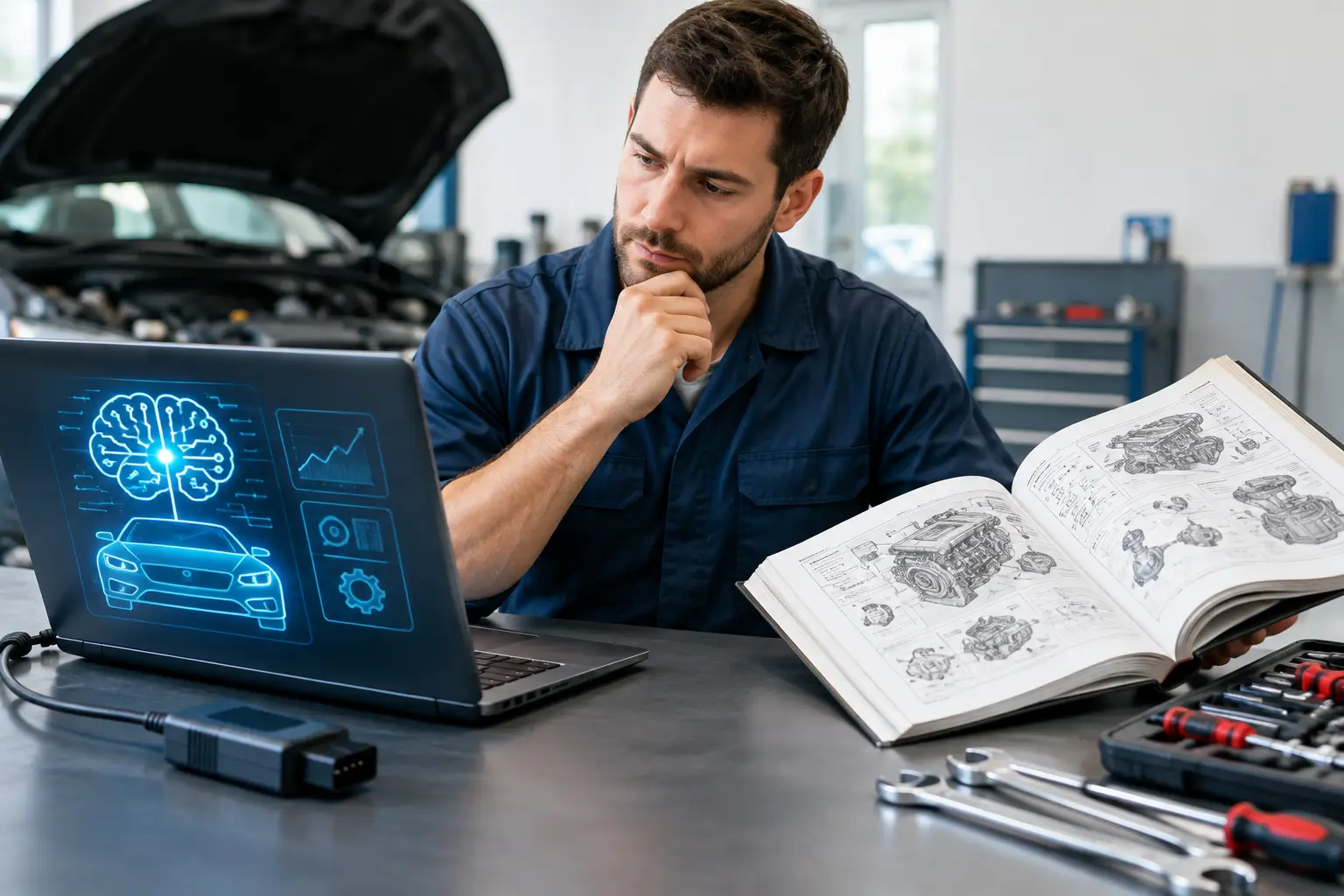
A customer says the refrigerator is warm, the freezer is frosting over, and the display is flashing an unfamiliar code. You can spend 20 minutes scrolling through a PDF, or you can start with a photo, a symptom, and an AI-guided diagnostic path. But neither option replaces the technician standing in front of the machine with a meter, a wiring diagram, and the judgment to work safely.
That is the real question behind AI diagnostics versus repair manuals. It is not about choosing a winner. It is about knowing which tool moves a service call forward, which tool confirms the repair, and where your own training has to take over.
For a new technician, that distinction matters. Customers do not pay for a page from a manual or an impressive-looking app screen. They pay for an accurate diagnosis, a safe repair, clear communication, and an appliance that works when you leave.
AI Diagnostics Versus Repair Manuals in the Field
Repair manuals have long been the backbone of appliance service. A good technical sheet can provide a wiring diagram, component resistance values, diagnostic mode instructions, parts breakdowns, and model-specific error-code definitions. When you need exact information for a specific unit, especially on an electronic control system, the manual is often the authority.
AI diagnostics changes the starting point. Instead of searching by model number and opening multiple documents, a technician can describe the symptom, upload a photo of the error code or data plate, and get a structured set of likely causes and next tests. That can reduce wasted time on the driveway, particularly when the failure is common but the model is unfamiliar.
The key difference is speed versus source authority. AI can organize the first steps quickly. A service manual can verify the circuit, test procedure, and specification that determine whether a part is actually failed.
A capable technician uses both. They do not replace electrical testing with a chatbot response, and they do not treat a 90-page manual as the only way to begin thinking through a failure.
What AI Does Better on a Busy Service Call
AI is most useful when the job is still messy. The customer description may be incomplete. The model number may be hard to read. The appliance may have several possible failure points. In those moments, the technician needs a fast way to narrow the path.
For example, a front-load washer that will not spin could have a door-lock issue, drain problem, unbalanced load condition, motor control fault, broken harness, failed tachometer circuit, or mechanical bearing failure. AI can help turn that broad complaint into a logical workflow: confirm whether the unit drains, check for stored fault codes, inspect the door lock, verify voltage at the motor circuit, and observe whether the control is commanding spin.
That is valuable because it prevents the rookie mistake of replacing the part that seems most likely. A failed spin cycle does not automatically mean a failed motor.
AI also helps with field documentation. A technician can use it to translate technical findings into customer-ready language, create job notes, organize photos, identify common error codes, and prepare a professional report. For an independent service business, that can improve consistency from the first customer text to the final invoice.
It is especially useful for technicians building speed across multiple appliance categories. One day may involve an ice maker, a dishwasher leak, an electric range burner, and a dryer with no heat. You still need the fundamentals, but AI can reduce the time spent hunting for the right diagnostic branch.
Where Repair Manuals Still Win
Manuals win when the repair requires model-specific proof.
A wiring diagram tells you how a circuit is supposed to operate on that exact appliance. It can show whether a thermal fuse is wired in series with the heater, whether the control board supplies neutral or line voltage, and which connector pin should be tested. That level of detail matters when you are working around 120- or 240-volt circuits, energized components, and sensitive control boards.
Manuals also matter for calibration procedures, service modes, disassembly sequences, sealed system specifications, and manufacturer test values. A thermistor may look identical across two refrigerator platforms while having a different resistance-temperature chart. A generic answer is not enough when you need to determine whether the sensor is within specification at a known temperature.
The same applies to microwaves. High-voltage components can retain dangerous energy even after the unit is unplugged. An AI tool may remind you of the hazard, but a trained technician must follow lockout/tagout practices, use the correct safety procedures, and know when a repair falls outside their current skill level. No digital tool makes unsafe work acceptable.
A manual is also the better source when an AI result conflicts with what you are measuring. Your multimeter reading, visual inspection, and circuit diagram should win over a generic recommendation every time.
The Risk of Using Either Tool Alone
A manual-only approach can be slow and fragmented. Technical sheets are often written for experienced servicers, not career changers learning how to build a diagnostic sequence. They may tell you the resistance range for a component without explaining what test should come first or how the customer’s symptom changes the decision tree.
That is why technicians who learn only by searching manuals can become parts changers. They find a code, locate a component, and assume the component is bad without checking the wiring, power supply, mechanical condition, or control signal.
AI-only diagnostics creates a different risk: false confidence. AI can recognize common patterns and guide useful checks, but it does not physically inspect a rubbed-through harness, hear a failing compressor relay, smell a burnt terminal, or verify voltage under load. It also cannot take responsibility for a diagnosis you did not confirm.
The technician still owns the workflow. Verify the complaint. Check for simple causes. Inspect for physical damage. Use the right meter setting. Compare findings against reliable technical information. Confirm the repair under operating conditions. Document what was tested and why the recommended repair is justified.
That process is what protects your reputation and prevents callbacks.
A Better Workflow: AI First, Manual Second, Meter Always
The most productive workflow is not complicated. Use AI early to organize the call, identify likely fault paths, interpret error codes, and surface relevant tests. Then use the model-specific repair manual to confirm wiring, specifications, and procedures. Finally, use your meter and observations to prove the failure before quoting or replacing parts.
Consider a dryer with no heat. AI may quickly identify the usual suspects: supply voltage, heating element, thermal fuse, high-limit thermostat, centrifugal switch, relay, and control board. The manual then shows the proper terminals and circuit layout. Your meter confirms whether the dryer has the required incoming voltage, whether the heater is open, or whether a safety device has failed.
That is diagnostics, not guessing.
The same structure works for refrigerator cooling complaints. AI can help sort symptoms such as clicking, frost patterns, fan operation, error codes, and temperature behavior. The manual provides the correct thermistor values, forced-defrost procedure, and board connector information. Your field tests determine whether the issue is airflow, defrost, compressor start components, a sensor circuit, or a sealed system problem.
This approach also improves customer communication. Instead of saying, “I think it is probably the board,” you can say, “I verified power to the unit, tested the heater circuit, checked the harness, and confirmed the control is not sending the required output. The control board is the failed component.” That language earns trust because it is backed by a documented process.
Why Training Is the Force Multiplier
The real advantage is not simply having an AI app or access to manuals. It is knowing how to interpret what both tools show you.
A structured technician education teaches the order of operations: safety first, symptom verification, electrical fundamentals, component testing, system behavior, repair confirmation, and customer documentation. It also gives you practice before a live customer is standing nearby waiting for answers.
Appliance Repair Academy builds that foundation through a 12-week curriculum, 80-plus scenario-based simulations, graded coursework, and a final certification assessment. Students work through laundry, refrigeration, cooking, microwaves, dishwashers, diagnostic workflows, and the business side of getting paid for their skills. The included AI diagnostic app is designed as a field tool alongside that hands-on reasoning, not as a shortcut around it.
That distinction can shape your income path. Service companies need technicians who can arrive prepared, follow a repeatable process, and close calls without unnecessary parts orders. Independent owners need the same technical judgment, plus the ability to create accurate job tickets, explain repairs, and protect margins.
The Tool Does Not Make the Technician
AI will make prepared technicians faster. It will not make untrained technicians safe, accurate, or ready to troubleshoot every appliance platform without verification. Repair manuals will remain essential. They are the technical record. But manual access alone does not build diagnostic instincts.
The technician who can combine AI speed, manufacturer data, electrical testing, and customer communication has a stronger position in the field. That person is not competing with technology. They are using technology to complete more confident, better-documented repairs.
Explore the training content on the Appliance Repair Academy site, then download the companion AI-powered diagnostic app for field support. The goal is not to memorize every appliance ever built. It is to build a process that helps you earn trust, solve problems, and keep moving toward paid work or business ownership.
Keep reading
How to Become an Appliance Repair Technician
Read moreAppliance Repair Certifications
Read moreAppliance Repair Technician Salary
Read moreLearn this the repeatable way
The Appliance Repair Academy is a 12 week online certification taught by a working technician. Tuition is $949 and covers laundry, refrigeration, cooking, and dishwasher systems, with the Appliance Repair AI diagnostic app included for a full year.
Explore the program