AI Diagnostic Adoption Is Changing Appliance Repair
AI diagnostic adoption helps appliance technicians troubleshoot faster, document better, and build field-ready skills without replacing hands-on judgment.
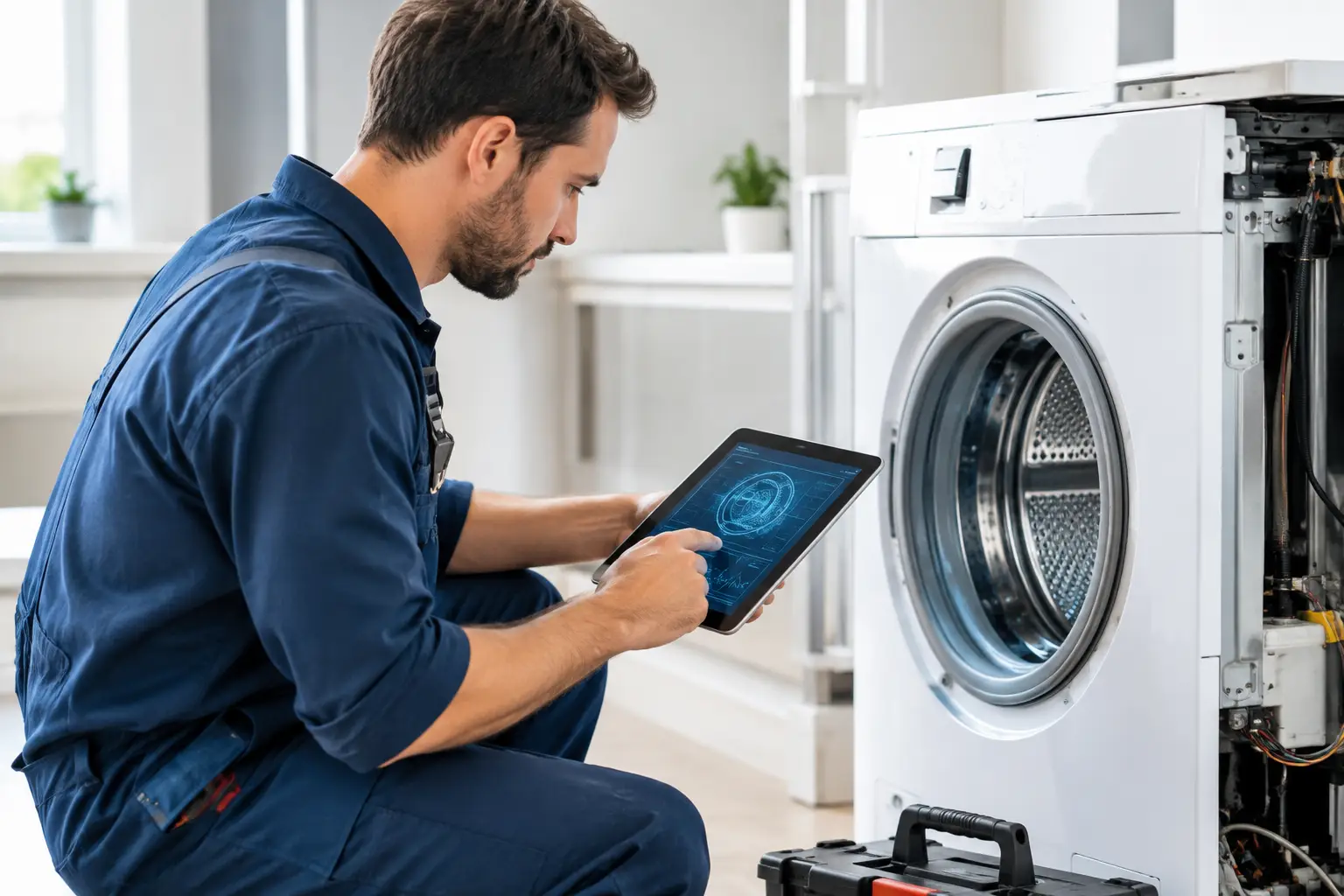
A refrigerator is warm, the compressor is running, and the customer expects a straight answer before you leave the driveway. That is where AI diagnostic adoption changes the working day for appliance technicians. It does not turn a new technician into an expert by pressing a button. It gives a prepared technician faster access to likely fault paths, model-specific information, wiring references, and documentation tools while the real work still happens at the appliance.
For people entering appliance repair, that distinction matters. This is a hands-on trade built on safe electrical testing, accurate observations, and the ability to explain a repair clearly. AI can reduce wasted time and help organize information. It cannot replace a multimeter reading, a visual inspection, lockout/tagout procedures, or the judgment required to decide whether a sealed system repair makes business sense.
Why AI Diagnostic Adoption Matters in the Field
Appliance service calls are rarely clean textbook problems. A dishwasher may display an intermittent error code. A dryer may heat with no load but fail under normal operating conditions. A customer may describe a refrigerator noise that is no longer happening when you arrive. The technician has to gather facts, test safely, eliminate possibilities, and document the result without turning a standard service call into a three-hour guessing game.
AI-assisted diagnostic tools can support that workflow by helping technicians identify common failure patterns from symptoms, photos, error codes, or model details. Used correctly, the tool gives the technician a more focused starting point. Instead of searching through scattered manuals or relying on memory alone, they can pull up likely components to inspect, relevant wiring information, and appropriate multimeter test guidance.
The value is speed with structure. A faster answer is only useful when it is based on the right diagnostic process.
For a career changer, this can shorten the gap between learning a concept and applying it on a service call. Thermistor diagnostics, door-switch circuits, defrost failures, drain pump issues, and ignition problems become easier to approach when the technician has a repeatable method: verify the complaint, inspect the unit, confirm power and safety conditions, test the circuit, identify the failed part, and document the repair.
AI Is a Force Multiplier, Not a Parts Cannon
The biggest risk in AI diagnostic adoption is using the technology as a shortcut to guessing. A tool may suggest that a failed control board is likely. That does not mean a technician should order one without checking incoming voltage, harness continuity, sensor resistance, fuses, relays, and the appliance's service information.
Parts cannon repairs cost money, damage customer trust, and make it hard to build a profitable service business. The technician who replaces three parts to solve one problem is not moving faster. They are creating callbacks, tying up cash, and losing time that could have gone to the next paid job.
The better approach is to treat AI output as a diagnostic lead. Ask: What evidence supports this likely failure? What reading would rule it out? What safety risk exists before I test? Is there a common wiring issue or mechanical condition that can produce the same symptom?
This is especially important on high-voltage appliances and complex systems. A microwave requires strict high-voltage safety procedures. A refrigerator sealed system issue requires a different level of training, equipment, and decision-making than a simple evaporator fan motor replacement. AI can organize reference material, but it cannot perform a safety check or take responsibility for a technician's actions.
The Technician Still Owns the Diagnosis
A strong technician uses three sources of information together: the customer's description, the appliance's actual behavior, and test results. AI can help organize the first two and point toward useful tests. The meter reading, pressure reading, continuity check, or physical inspection is what confirms the diagnosis.
That is why training matters before tool access. Technicians need to understand voltage, resistance, continuity, amperage, component functions, and safe testing practices. Without those fundamentals, a suggested fault path is just a list of words. With them, it becomes a practical field resource.
Where AI Helps New Technicians Most
New technicians do not need more random information. They need a system for using information under pressure. AI diagnostic tools are most useful when they support the parts of the job that commonly slow beginners down.
First, they can help translate a vague complaint into a testable problem. "My washer keeps stopping" can involve a lid lock, drain restriction, pressure switch, control issue, motor fault, or user-related condition. A structured assistant can prompt the technician to gather the model number, error code, cycle behavior, voltage status, and relevant visual clues before jumping to a conclusion.
Second, photo-based assistance can help identify components, damaged connectors, visible leaks, and likely locations of service information. It is not a replacement for verifying part numbers or wiring paths, but it can reduce time spent searching when a technician is unfamiliar with a model.
Third, error-code lookup and wiring references can help technicians stay organized across multiple appliance categories. Laundry, refrigeration, cooking equipment, dishwashers, and microwaves each have their own common failure patterns. A technician building a career needs broad exposure without pretending every unit operates the same way.
Finally, customer-ready reporting can improve the closeout process. Customers want to know what failed, what was tested, what the repair costs, and whether the appliance is worth fixing. Clear job tickets and plain-language summaries make a business look professional and reduce confusion after the technician leaves.
The Adoption Standard for a Service Business
For an independent technician or future service-company owner, adopting AI should improve measurable parts of the operation. If it does not reduce research time, improve diagnostic consistency, strengthen documentation, or help prevent callbacks, it is not earning its place in the truck.
Start with a controlled workflow. Use the tool after collecting the model number, symptom details, and basic inspection results. Compare its suggestions with the service documentation and your own test plan. Record the final diagnosis, parts used, readings taken, and customer recommendation. Over time, review which calls were resolved on the first visit and where delays occurred.
This approach protects the business from overreliance while building a library of better decisions. It also gives newer technicians a professional process to follow. The goal is not to look high-tech. The goal is to leave more homes with an accurate diagnosis, a documented recommendation, and a customer who feels confident about the next step.
There is also an income angle. Technicians who diagnose efficiently can complete more quality work, reduce unbillable research, and protect their reputation. That does not guarantee six-figure income. Market rates, route density, customer acquisition, specialization, and business discipline all matter. But diagnostic speed paired with accuracy is one of the clearest ways to create capacity in a repair business.
Training Should Come Before Tool Dependence
The best entry point into appliance repair is structured training that teaches the reason behind each test. Students should learn electrical fundamentals before troubleshooting control circuits, safety before microwave service, and systematic workflows before handling complex refrigeration complaints.
At Appliance Repair Academy, the 12-week program combines technician-built instruction with 80-plus scenario-based simulations, graded coursework, and a final certification assessment. Students practice the diagnostic sequence across major appliance categories, then use AI-assisted resources as part of a field-ready workflow rather than as a substitute for technical skill.
That combination reflects how successful technicians actually work. They use tools, references, and support when needed. They also know how to verify a failure, communicate with customers, quote responsibly, and make a decision when a repair is not economically sensible.
AI diagnostic adoption will keep expanding because appliance technology is becoming more connected, more electronic, and more model-specific. The technicians who benefit most will not be the ones who blindly follow the first suggestion on a screen. They will be the ones who pair digital speed with disciplined testing, safe work habits, and the confidence to stand behind their diagnosis.
Explore Appliance Repair Academy content to see how structured training builds real service-call readiness, then download the companion AI-powered diagnostic app to support your hands-on diagnostic workflow. The strongest advantage is not having AI in your pocket. It is knowing exactly how to use it when the customer is waiting for an answer.
Keep reading
How to Become an Appliance Repair Technician
Read moreAppliance Repair Certifications
Read moreAppliance Repair Technician Salary
Read moreLearn this the repeatable way
The Appliance Repair Academy is a 12 week online certification taught by a working technician. Tuition is $949 and covers laundry, refrigeration, cooking, and dishwasher systems, with the Appliance Repair AI diagnostic app included for a full year.
Explore the program